Mom gets Covid - Part 1
A quick note: This story has progressed over at least 4 different edits. I first published the story in December of 2020, alongside me learning about everything from blood pressure to our initial knowledge of COVID-19. I've since then edited the piece at least 3 more times, the latest being November 2026, as new information and the advent of AI have come about. Please keep that in mind as you read this article, you will be able to see new information coming to light in the form of highlights, strikethroughs and updates.
The day was November 26, 2020. My sister looked at her cell. She was getting a call from the
Personal Care Home in Winnipeg, Canada where our 93 year old mother is living
out her last years on this planet. It is a wonderful home that has recently
been overcome with large numbers of staff and residents contracting the Corona
virus. The call coming in confirmed her worst fears. Mom had tested positive
with Covid-19. At first her only obvious symptom was that she had lost her sense of taste, one of the early tell-tale signs of Covid-19. My sister's calls to mom intensify.
 |
| COV2 photo by PIRO4D from Pixabay |
My sister, who is a Registered Nurse, had been getting daily reports from the staff leading up to that
call, that mom wasn't drinking or eating as much as usual. My sister, while
cautious, chalked it up to different staff not knowing how much she normally
ate. But she continued the 2 to 3 daily calls to check in on mom.
Ever since the lockdowns, visits to the home have been limited and when the
outbreak was announced at the home, there were no visitors allowed at all.
Visits became restricted to a case-by-case basis for compassionate reasons,
mostly for terminal residents.
On November 27, mom is transferred to the Red zone area for closer monitoring. The staff on
that unit were very busy, looking after the COVID-19 sick residents and as
such, not able to answer the family phone calls. The social workers from the
facility provided daily updates to the resident’s primary caregiver. The
reports about mom on Saturday, Sunday and Monday were vague said my sister and
she could not get many details about mom’s condition. My sister then moved to
plan B. Even though it was not established protocol, she called the nursing
station on the COVID-19 unit on November 30th. She asked to speak to mom. A staff member called
my sister back on a cell phone and then passed the phone to my mom.
"Hello?" comes the weak welcome.
"Mamo, how are you doing?" asks my sister.
"Not good. Everything hurts" comes back the reply in a voice
seemingly on the edge of death.
After a short conversation, my sister calls the COVID-19 unit back
and speaks to the nurse.
"What are you doing for mom?" she asks.
"We are monitoring her" comes back the reply.
"What do you mean monitoring her?" my sister replies.
"Is she drinking fluids and eating?"
"Barely" responds the nurse.
"Then she is likely dehydrated. Which would explain why she
sounds so weak. She needs an IV. Please get the doctor to order her an IV
immediately.“
For those that don't know what an IV or Intra Venous is, according to Wikipedia it is:
"a medical technique that delivers a liquid directly into a person's
vein. The intravenous route of administration is commonly used for rehydration
solutions or to provide medications in those who cannot consume food or water
by mouth."
In other words, if you aren’t getting enough water into your body, this
is one way of putting it in – directly into your veins using a needle, a tube,
a bag full of water and some salt or sugar (dextrose).
The nurse let my sister know that there wasn’t anyone on staff that could do
that for her at that time but that she would speak to the Doctor about the Community IV program.
 |
| IV Therapy |
The CIVP program was established in our city to assist with getting people IV therapy, but outside the traditional hospital setting. To lessen the burden on hospital infrastructure. The CIVP program is now housed at Misericordia Hospital, but is mobile and can visit people in their homes or nursing homes as well to administer IV Therapy.
At that point, my sister was pretty sure that dehydration was the
root of our mother’s condition. So she made the best decision available to her at the time, based on the information she had in front of her. She could not wait for the doctor to make the call for a CIVP nurse to administer an IV to mom. She asked the nurse on the phone, that an ambulance be called
immediately to transport our mother to the hospital and awaited by her cell
phone for confirmation. The Nurse called her back.
"We've called an ambulance. They are on their way."
My sister found out that when the EMT's picked her up
that her blood pressure was very low. Since that time, I have received copies of the entire medical report. Upon picking mom up, the EMT's measured her BP at 17:20 November 30, 2020. It was 72/56 NIBP (Non Invasive Blood Pressure), which was dangerously low (normal is closer to 120/80). They immediately treated her en route to the hospital with a 500ml IV solution of 0.9% saline. When the EMT's arrived at Emergency at 17:47 that same day, her blood pressure was now at 84/35 NIBP.
The EMTs had transferred her to
the ER at St. Boniface Hospital where she was evaluated and admitted for AKI (Acute Kidney Injury), Hyperkalemia (too much potassium) and Covid-19. The ER continued with IV
fluids and kayexalate and then transferred to the COVID unit in the hospital for
further treatment.
We know what IV fluids are. What is kayexalate?
"
Great video about hyperkalemia (too much Potassium) here at WebMD.
Mom stayed put at the hospital for 5 days. The hospital ran tests on her blood on as soon as she arrived while continuing the IV application. Out of the 39 values on her admission bloodwork, 24 came back normal. The other 15 were flagged as higher (H) or lower (L) than normal:
RBC (Red Blood Cell) Low - Could indicate a vitamin deficiency, internal bleeding, kidney disease or malnutrition
HGB (HemoGlobin) Low - Low Hemoglobin leads to Anemia, symptoms of fatigue and breathing trouble
HCT (Hematocrit) Low - Volume percentage of red blood cells in our blood
RDW (Red Blood Cell Distribution Width) High - measurement of the range in volume and size of the red blood cells
IPF (Immature Platelet Fraction) High - the share of young, newly released platelets in the blood. A high value means the bone marrow is replacing platelets quickly, which happens with infection and inflammation.
Neutrophils Percent - High - a shift toward neutrophils, common during acute illness and physical stress
Lymphocytes Percent - Low - the other side of the neutrophil shift; together they point to an acute illness.
ABS Lymphocytes - Low - a low lymphocyte count (lymphopenia) is one of the most consistent blood findings in Covid-19
Potassium Level - High - risk of dangerous heart rhythms and cardiac arrest
Chloride Level - High - can come from dehydration, and also from the saline she had just been given by the paramedics
CO2 Total - Low - a sign of metabolic acidosis, meaning her blood had become too acidic. That fits kidneys under strain, and it's why she was later given sodium bicarbonate.
Urea - High - created during dietary protein turnover. Abnormalities usually signal troubles with the kidneys
Creatinine - High - when high, there may not be enough blood flow to the kidneys as the kidneys normally filter this end product of metabolism out
Urea/Creatinine ratio - High - the classic pattern when the kidneys aren't getting enough blood flow (doctors call it "pre-renal"). This is the strongest single sign of dehydration in her bloodwork.
Magnesium Level - High - indicates possible kidney failure
The attending physician also stopped her from taking 3 drugs that were working against her present condition of low blood pressure, high potassium and dehydration.
Furosemide - is a strong diuretic (water pill) that helps your body get rid of excess water. It does this by increasing the amount of urine your body makes. If you take too much of this drug, it can lead to very low amounts of water and electrolytes in your body. This can cause dehydration.
Spironolactone - is used to treat high blood pressure and heart failure. Lowering high blood pressure helps prevent strokes, heart attacks, and kidney problems. It is also used to treat swelling (edema) caused by certain conditions (such as heart failure, liver disease) by removing excess fluid and improving symptoms such as breathing problems. This medication is also used to treat conditions in which the body is making too much of a natural substance (aldosterone).Spironolactone is known as a "water pill" (potassium-sparing diuretic).
Ramipril - is used to treat high blood pressure (hypertension). Lowering high blood pressure helps prevent strokes, heart attacks, and kidney problems. Ramipril is also used to improve survival after a heart attack. It may also be used in high risk patients (such as patients with heart disease/diabetes) to help prevent heart attacks and strokes. This medication may also be used to treat heart failure in patients who have had a recent heart attack. Ramipril is an ACE inhibitor and works by relaxing blood vessels so that blood can flow more easily.
So the question from this writer would be simple. If a nursing home patient is taking any sort of drugs for lowering blood pressure, would it not make sense to monitor such a patient for abnormal blood pressure? To either adjust or remove the meds? As clearly, they were working counter-intuitively in this case. Furosemide was causing her to urinate more frequently. Dehydrating her. Spironolactone was doing the same - dehydrating mom. But retaining potassium, which is something she had a bit much of at the end. Ramipril belongs on that list too. It lowers blood pressure, the last thing you want in someone who is already dehydrated. It also makes the body hold on to potassium. Paired with spironolactone, which does the same, it's a well-known recipe for dangerously high potassium, especially when the kidneys are under strain. That is exactly what the hospital found.
Update October 2026: It turns out there's already a name for what should have happened: "sick-day rules." Diabetes Canada, for example, teaches the memory aid SADMANS, a list of drug types (including ACE inhibitors like ramipril and diuretics like furosemide) that should be paused when someone stops eating or drinking because of illness. They're restarted once the person is eating and drinking normally again. Mom was on three of these drugs and had nearly stopped drinking. Nobody paused them.She fell at least once, after getting caught up in her IV tubing while she was roaming around her room looking for a washroom. No fault of the staff there, as I can't even imagine what their working conditions are like. But kudos to a woman that survived World War 2 and 2 different invading armies, was able to leave Ukraine at the height of the cold war in 1960 by being granted a 1 in a million visa to meet her father for the first time in her life (long story), raised her 2 kids by herself after her husband died 11 years into their marriage and able to bounce right back up and keep going. She wasn’t giving up. Even while on an emergency ward. She simply had someone help her back up that day and get her to the bathroom.
Nursing staff then called my sister as mom decided to go into "I don't
understand you" mode. Sis then donned her other hat, as translator for
mom. Apparently, she was up and about again, but this time, she was looking for
her walker. Which unbeknownst to her, hadn't made the ambulance trip with her
to the hospital. So, the staff on her floor located a walker for
her and set up a commode chair in her room to avoid further falls.
The next day occupational therapist came to see her to ensure that
she liked the walker the staff had found her. She did. For 5 days she
stayed confined to her room with an IV in place, that she frequently pulled out
when she needed to get to the commode or washroom. Ouch. The doctor on the
floor, the nurse practitioner, and various nurses over the course of the 5 days
called my sister with updates and assisted my mom when my sister called in to
talk to her. And over those 5 days, the staff at the hospital
performed a miracle, and saved my mom's life. No ventilator. My sincere thanks to these unnamed individuals.
Here were the list of drugs and fluids, that my mom had administered to her either orally (tablet) or via injection (inj) during her stay:
Medications
haloperidol (inj)- for delirium, the sudden confusion common in elderly patients during serious illness
acetylsalicylic acid EC (low-dose aspirin, tablet) - to reduce the risk of heart attack and stroke
metoprolol (tablet) - prevent heart attack, stroke
cyanocobalamin (tablet) - vitamin B12
allopurinol (tablet) - to lower uric acids in your blood. Too much uric acid can cause gout or kidney stones
heparin (inj) - to prevent blood clots, standard for hospitalized Covid-19 patients, who have a higher clot risk
dimenhydrinate (Gravol) - to help prevent nausea and vomiting
acetaminophen (tablet) - to help with pain
insulin with dextrose (inj) - an emergency treatment for high potassium. Insulin drives potassium out of the blood and into the cells, and the dextrose (sugar) is given alongside so her blood sugar wouldn't crash.
sodium bicarbonate (inj) - to correct the acidosis and help move potassium back into the cells
calcium gluconate (inj) - to protect her heart from the high potassium while the other treatments brought it down
IV Therapy
NaCL 0.9% - for rehydration
Dextrose 5% NaCL 0.45%
Multiple tests throughout the 5 days she was there. Blood work, xrays, ECG (Electrocardiogram), Physiotherapy, Occupational Therapy, Infectious control, Clinical Research, Internal Medicine teams all played a part in her recovery. Nursing was wonderful, with constant monitoring of fluid balance, blood glucose, vital signs, IV and cardiac function. She was admitted to ER was because she was severely dehydrated, her potassium levels were abnormally high and her blood pressure (bp), abnormally low at 84/35. CTAS (Canadian Triage and Acuity Scale) Level 2 - Emergent - Conditions that are a potential threat to life, limb or function.
She survived because she received critical IV therapy (fluid and
electrolytes) to assist with dehydration and a drug to rid her of her excess potassium. The two biggest threats to her continued life.
Update November 2026: Her emergency treatment included IV fluids, withholding ramipril, spironolactone and furosemide, and treatment to protect her heart and lower her dangerously high potassium. Together, these measures addressed her dehydration, acute kidney injury and hyperkalemia.
When she left, her bp was at 108/43. Kudos to the entire St. Boniface Hospital staff. Job well done.
My sister called it. She had been nursing for 35 years. Easy call for her as she has seen dehydration many times before. She had not overreacted. Sis was instrumental in extending my mom's life.
My sister heard through the grapevine, that within days of her mom
being transferred to the hospital, that the Nursing Home now had Community IV Program (CIVP) nurses helping administer IVs to patients in need of rehydrating. In
communication with the home, I was able to confirm that discussions had been
underway to get these IV nurses into place well before my mom's adventure. That in fact, according to the nursing home management, CIVP had already visited the home on a number of occasions. Including getting volunteers on site to help with hydrating the
residents.
The name of this Nursing Home is irrelevant. The people that run it
have hearts made of gold. They were under informed, understaffed and
overwhelmed by something that we are just beginning to understand. Let
this be clear, my beef is not with them. We have all been
blindsided by this virus. It goes beyond that. Vital and critical
information that is very simple for the millions of people being affected by
Covid-19 is NOT being disseminated, by governments the world over. That
information is the role that water, simple water plays in this
entire drama.
If we hydrate before, during and after Covid-19 infection, we may have a greater chance of surviving this challenge.
 |
| Drink enough water. Before, during and after Covid-19 |
I have tried personally to get in touch with our local government. My emails have fallen on inboxes that do not reply. I have tried calling and left on hold for hours. So, I am left with social media and blogs as the only way to get this information out. It is not to vilify anyone, not even the government in the end. It is simply to get the information out that you need to hydrate before, during and after Covid-19 infection.
The message that a lot of people are dehydrated is critical to this woman's story. The message that hydration during a pandemic is important to all of us, is being missed. Masks continue to be important. We wear our cloth and paper masks to lessen the chance that we don't infect others if we are infected. Social distancing is important. To avoid catching it yourself or to stop spreading it to others if you suspect you may have it. However, both masking and social distancing are selfless acts, that are for other people, unless you have the money or where with all to source an N95 mask. Which of course if worn properly can actually protect the wearer. Social Distancing is also for others, unless you have the money to purchase and install an NBC bunker. Which could technically protect you and your loved ones from Covid-19.
Hydrating is for the one wearing the mask. Hydrating is for all you brave souls social distancing or self isolating. Or on the front line. You need to hydrate sufficiently. All depending upon a variety of factors including body weight, level of activity, humidity, environment, age, diet, etc. More so, if you are ill. Do your own homework. But do what it takes to ensure that you are hydrating enough.
There is a chance that dehydration has played a big role during this pandemic. The stories in our own town seem to point in that direction. Simply because the lack of proper hydration may have set them up for allowing the virus to actually get into their cells and gain a foothold to replicate itself. After which, all hell breaks loose.
Hydration is something that doctors have been telling us to do for thousands of years. Drink plenty of water throughout your day. If you get sick, rest and get plenty of fluid. Unfortunately, for a lot of seniors who rely on someone else to get that water into them, that isn’t happening.
Mom returned to the nursing home 5 days later where my sister has been allowed as a Nurse, to don full PPE gear and go onsite to help her mother eat and drink at mealtimes to avoid further hospitalization due to dehydration. Our mother is now (October, 2021) as good as or better than she was prior to being infected by Covid-19. The medical staff are attending to her daily and adjusting her medications appropriately after her reboot in hospital. And maybe, just maybe because of her little stubborn daughter that wouldn't give up. Way to go sis.
We will all die. Mom knows she is destined to meet her maker. She has made peace with that fact, as have we, her family. But this was not the way it was going to happen. By dying of complications of lack of water in a land of plenty.
(Update October 2026: Mom passed away in May 2022. The full story of her care, and what I’ve learned from her records since, is the subject of research I’m preparing for publication. I’ll link it here when it’s out.)
What dehydration has to do with Covid-19 - Part 2
Update October 2026: What's changed since I first wrote this in December of 2020:
• Randomized trials did not support routinely stopping ACE inhibitors or ARBs solely because a patient had COVID-19. That does not apply to patients with separate clinical reasons to hold them, such as hypotension or acute kidney injury. I no longer have evidence that ramipril protected Mom against severe COVID-19.
• The ACE2 "cleaving" theory from the video I relied on has largely not held up. I've added notes where it appears.
• What has held up is the danger of diuretics and blood pressure drugs in elderly people who stop drinking. That's now the heart of this story.
Disclaimer: What follows is what I learned from doing research on the Internet. We all know the limitations of the Internet. This is what I learned. Do your own research to verify everything that I have written is as close to the truth as possible. If there are mistakes or omissions I welcome the critique. With that admission of my own limitations, I continue the story.
My mom's encounter with Covid-19 laid the context for what came next.
My first question was, were there any precedents for what happened
to our mother?
Cut to a few news articles. The first from CTV news about recent dehydration issues and problems at Maples
Nursing Home. Then an eerily similar story by the Globe and Mail about Parkview Nursing home with more of the same problems
involving hydration or lack thereof. Finally a story that made me stop in my
tracks care of the CBC.
"Dehydrated and not eating, Walter Eschuk quickly took a turn
for the worse.
The 89-year-old Winnipeg man tested
positive for COVID-19 while inside Maples Long Term Care Home. He died on
Nov. 14.
"It wasn't expected because they kept telling us he was asymptomatic
and I guess I didn't ... realize how serious dehydration could be," said
Eschuk's daughter Teresa in an interview from Ottawa on Sunday."
And this story. As if someone hasn't learned from our previous mistakes.
Multiple stories. Multiple similarities. Patients getting Covid-19.
Patients asymptomatic. Patients stopping drinking water and eating.
Dehydrating. And dying. Bear in mind, this is just Winnipeg.
What was going on? And was there a link between Covid and dehydration?
Digging a little more, I found
this gem at the US National Library of Medicine. In a research paper
published Nov 20, 2020 a hypothesis has been put forward by 5 scientists
(Stookey, Allu, Chabas, Pearce and Lang) that says the following in it's
opening paragraph:
"To address urgent need for strategies to limit mortality from
coronavirus disease 2019 (COVID-19), this review describes experimental,
clinical and epidemiological evidence that suggests that chronic sub-optimal
hydration in the weeks before infection might increase risk of COVID-19
mortality in multiple ways."
The paper had my attention. I read on.
Disclosure October 2026:
Since writing this, I have worked with Dr. Jodi Stookey, the paper's lead author, on research into dehydration in elderly patients.
"chronic sub-optimal hydration in the weeks before exposure to
COVID-19 may conceivably result in: greater abundance of angiotensin converting
enzyme 2 (ACE2) receptors in the lung, which increases likelihood of COVID-19
infection"
Now I tried reading the rest of the paper. Honestly. But their paper went into
so many different directions and included so many specific details, that I
thought I needed a more lay introduction to ACE-2 before I even tried digesting the rest of that paper.
So I went hunting. What the heck was ACE-2? I found this video by Dr. Klioze. Full marks to this gentleman for producing this video. Note: Since I wrote this article, I have found out that Dr. Klioze created the video based on a hypothesis of how RAAS affects the ACE-2 receptor. More research is vital.
His video starts
by explaining that the:
"Covid-19 virus seeks out a specific surface protein molecular
target to gain access to our cells called ACE-2".
So now I knew how the virus was getting into our bodies' cells. Via the ACE-2
protein receptor path. I garnered this knowledge in the first 15 seconds of the
video. What the heck was the rest of the video about? Let's put it this
way. There isn't a single second of this video that wasn't an eye
opener.
Dr. Klioz goes on to explain how ACE-2 protein receptors are found in the
lungs, the GI Tract (which includes the mouth, esophagus, stomach, small
intestine, large intestine and yes, the anus), Kidneys and blood vessels. Talk
about an abundance of targets.
He then mentions the how response to COVID-19 ranges from asymptomatic (no sign
of the disease externally) to death. Which he concludes that there must be
person to person variability in either the configuration or number of
ACE-2 receptors found in everyone's bodies.
The RAAS system and its close ties to ACE-2
Renin-Angiotensin-(Aldosterone)-System (RAAS) was next. In order to understand
what the functionality of ACE-2 was in our bodies, Dr. Klioz had to explain
this closed-loop feedback system worked in all our bodies. This system involves
the kidney, the liver, the lungs, the arteries and the adrenal organs.
One could say, that the primary existence of the RAAS system is to help maintain renal (kidney) blood
flow. There may be other reasons for it's existence, but keeping up blood flow and hence blood pressure could be said to be it's biggest responsibility. The kidney's job is to clean our blood, and filter out Nitrogen waste
products that accumulate during Protein Metabolism. The kidneys get rid
of the excess nitrogen by creating urine or pee, by any other name. To
do this very vital function, the kidneys need a steady flow of blood. About 25%
of total cardiac output. Here's where it gets juicy. At 1:24 in the video he
says the magic words.
"1:22 A drop in blood pressure, either systemically from heart failure or
locally from a narrowing of the renal artery supplying blood to the kidney
causes the kidney to..."
Dr. Klioz mentions two very specific ways of dropping
blood pressure. Heart failure and narrowing of the renal artery. But I
just learned, having gone through this most recently with my mom, that
dehydration checks this box as well. As mentioned earlier in this article, since writing this article, I pulled her medical papers regarding her visit. Her NIBP was 72/56 when the EMT's checked it on picking her up. After a 15 min ride in the ambulance, and 500ml of IV fluid, her BP was 84/35. Though the EMTs might think otherwise, her rise in BP wasn't due to the sudden attention she had from 2 handsome young men attending to her dire situation. It was because of the water and sodium. On with the video. Update Nov 2026: The EMTs started IV saline during transport. At 17:47, her BP was recorded as 84/35. The upper number had risen, but the lower number had fallen; her blood pressure remained dangerously low. Treatment continued in the ER. On with the video.
"...1:29 causes the kidney to secrete a chemical called Renin into the
bloodstream. Renin then links to a protein hormone produced in the liver called Angiotensinogen
converting it into Angiotensin-1"
Got it so far. My mom's kidneys
were responding to low blood pressure (hypotension) by secreting the enzyme
Renin. Renin was then binding to the Angiotensinogen hormone (which is produced
by the liver) in the blood to produce Angiotensin-1 hormone.
Questions abound. Why is the liver producing Angiotensinogen? Was
it in response to the Renin? Or is it always producing it? More research was
needed. On we go with Dr. Klioze's video.
"1:43 A second enzyme produced in the lungs, called Angiotensin Converting
Enzyme, or ACE, then links to Angiotensin-1 converting it to Angiotensin-2, the
active configuration of the hormone"
So three major organs are now involved. Quick recap.
Renin (an enzyme created by the kidneys in response to low blood pressure),
assists in producing the hormone Angiotensin-1 by meeting up with
Angiotensinogen (a hormone which was produced by the liver) in the bloodstream.
Angiotensin-1, the "child" of Renin and Angiotensinogen, then gets
another do-over when it bumps into the enzyme ACE (which was produced by the
lungs) and gets a newfound life as Angiotensin-2 hormone.
Double recap.
Renin enzyme changes Angiotensinogen into Angiotensin-1
ACE enzyme changes Angiontensin-1 into Angiotensin-2

More questions. Why were the lungs producing ACE? I kept watching as Dr. Klioze narrated.
"1:54 Angiotensin-2 then acts on both the peripheral arteries throughout the body and the Adrenal glands. The arteries constrict. And the Adrenal glands produce another hormone called Aldosterone which causes the kidneys to absorb more salt and water from the urine. The combination of vascular constriction and saltwater retention raises the systemic blood pressure and restores blood flow to the compromised kidney."
Wow. What a very needy organ. Need more blood flow? Kidney sends out Renin, which ultimately converts Angiotensinogen produced by the liver to Angiotensin-I and then the lungs kick in their part of the equation with a bit of ACE enzyme to turn the Angiotensin-I into an active hormone called Angiotensin-II.
Update: Dec 26, 2021
Reading an article by Fountain et. al entitled Physiology, Renin Angiotensin System, I came across this little gem:
"Angiotensin II also acts on the adrenal cortex, specifically the zona glomerulosa. Here, it stimulates the release of aldosterone."
"Finally, angiotensin II acts on the brain. Here, it has three effects. First, it binds to the hypothalamus, stimulating thirst and increased water intake. Second, it stimulates the release of antidiuretic hormone (ADH) by the posterior pituitary. ADH, or vasopressin, acts to increase water reabsorption in the kidney by inserting aquaporin channels at the collecting duct. Finally, angiotensin II decreases the sensitivity of the baroreceptor reflex. This diminishes baroreceptor response to an increase in blood pressure, which would be counterproductive to the goal of the RAAS."
So, in addition to vasoconstricting blood vessels, thereby increasing blood pressure, Angiotensin II does the following:
1. Angiotensin II acts on the adrenal glands (which sit on top of the kidneys) and stimulates the release of Aldosterone which gets the kidney to absorb more salt and water from the urine, and increases potassium excretion, thereby increasing blood pressure
2. Angiotensin II acts of the brain where it binds to the hypothalamus and is responsible for stimulating thirst and increased water intake, which will eventually increase blood pressure
We'll circle back to Angiotensin II later.
Update: September, 2021. Dr. Klioz left out some critical information in his video. The following is a new hypothesis that was put together by Donato Zipeto et. al on the Interplay between ACE2/ADAM17/TMPRSS2.
Angiotensin-II is a RAAS response to increase BP. Angiotensin-II binds to a receptor site called Angiotensin Type 1 Receptor (AT1R) shown below in this graphic. In doing so, it vasoconstricts blood vessels and raises BP and leads to a series of harmful side effects in which ADAM17 plays a central role.
Update October 2026: When Angiotensin II binds to AT1R it does more than tighten blood vessels. According to Zipeto and colleagues, it also switches on an enzyme called ADAM17, which cuts ACE2 off the cell surface. That sounds helpful, with fewer doors for the virus, but it removes the very enzyme that turns Angiotensin II into protective Angiotensin 1-7. So ACE2 shedding belongs to the harmful side of the system.
The cut-off pieces (soluble ACE2) can float in the blood and latch onto the virus's spike. That's why researchers tested lab-made soluble ACE2 as a treatment. But the body's own levels are low, and Covid patients with more of it in their blood tended to do worse, not better.
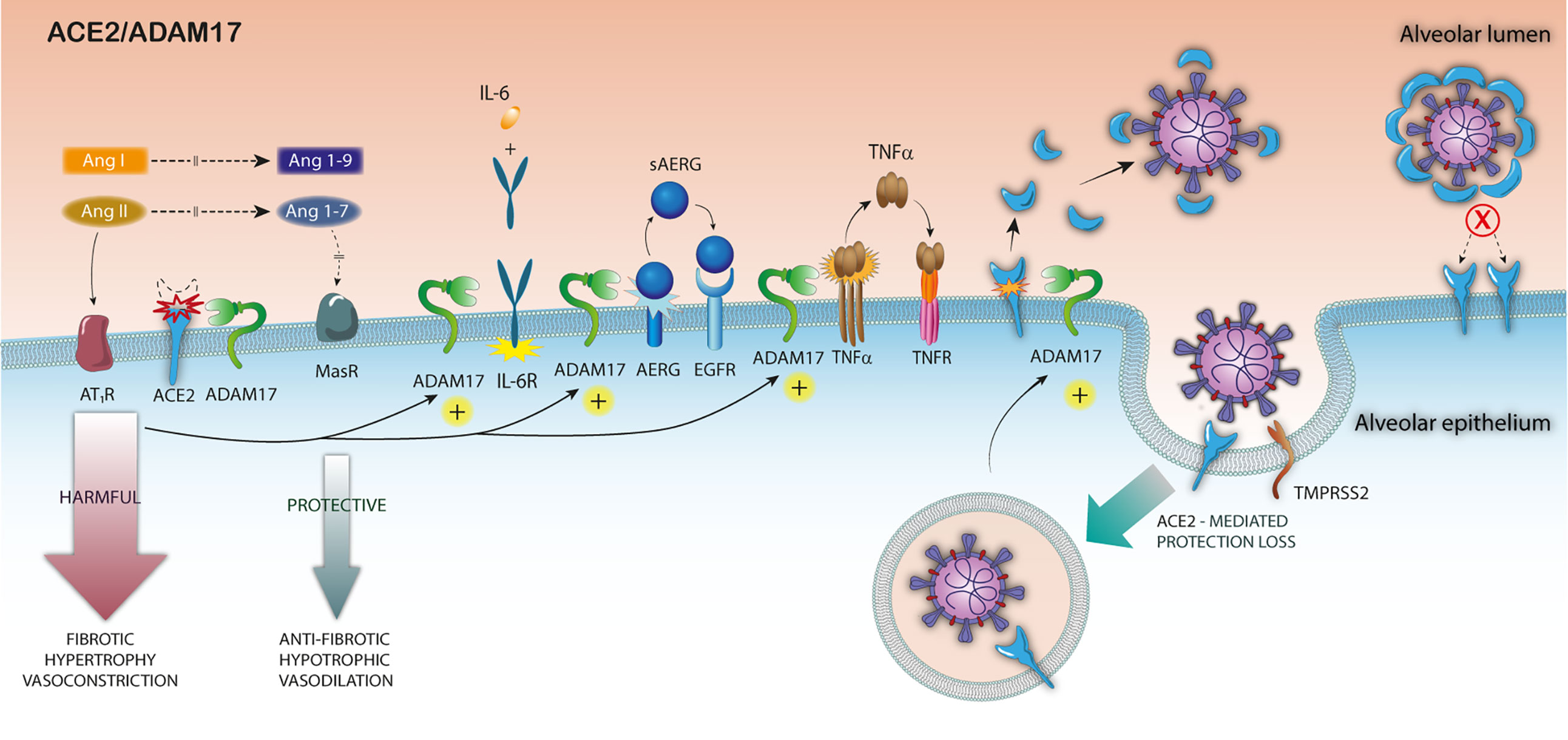
A diagram of the relationship between ACE-2 and ADAM-17, the unnamed sheddase in Dr. Klioze's video. Diagram from ACE2/ADAM17/TMPRSS2 Interplay article by Donato Zipeto et al.
Talk about an amazing closed-loop feedback system. And this is only HALF of the
closed loop. The part that tries to increase the blood pressure.
How ACE-2 figures into this
Done with RAAS, Dr. Klioz now concentrates on the ACE-2 protein found on the
outer membrane of certain cells in locations previously mentioned. Namely, the
GI tract, the lungs, the kidneys and blood vessels throughout our body.
Remember, the ACE-2 receptor is how the Covid-19 virus gets into our cells and
wreaks havoc. Dr. Klioz continued.
"3:25 The active form of ACE-2 (soluble ACE-2) is produced by an additional enzyme called Sheddase (Adam17). Sheddase (Adam17) cleaves the external component of the ACE-2 protein and
releases it into the bloodstream (as soluble ACE-2)."
We now know, thanks to Donato Zipeto et al that the Sheddase is in fact, ADAM17. That the cleaved ACE2 that was released into the bloodstream is called sACE2 or soluble ACE-2.
"3:36 The cleaved portion of ACE-2 interacts with Angiotensin-2, converting
it into Angiotensin 1-7.
Angiotensin 1-7 is a powerful antioxidant and vasodilator, dilating the
peripheral vessels of the body and eliminating the action of Angiotensin-2 on
the adrenals. Angiotensin 1-7 lowers blood pressure and is basically the
counter-balance to Renin-Angiotensin (Aldosterone) System."
Wow.
Recap: So low blood pressure triggers the Renin Angiotensin
Aldosterone System which constricts arteries throughout the body and has the
kidneys retain salt and water and expel potassium. To raise blood pressure.
When the body has had enough high blood pressure and wants it to go back down
to normal levels, something triggers the ADAM17 enzyme to
cleave a portion of the ACE-2 protein molecule away from itself and
sacrifice those pieces of ACE-2 to alter the workings of the Angiotensin-2
hormone, turning it into Angiotensin 1-7. Which does just the opposite, of what
Angiotensin-2 was doing. Angiotensin 1-7 lowers blood pressure by
dilating (or opening up) all constricted arteries and stops the Kidneys
from retaining salt and water by converting any free floating Angiotensin II into Ang I-7.
A true closed-loop feedback system. An elegant one at that. One that researchers and drug companies were able to exploit in order to stop hypertension or high blood pressure. If the body is sending out signals via the RAAS system to raise blood pressure via this pathway, researchers asked,
"What if we could short circuit the RAAS system that appears to be "out of control" and stop the message of "raise blood pressure" from getting all the way to end of this system (Angiotensin II binding to the AT1R receptor and vasoconstricting blood vessels) and ADAM17 (the quarterback of this system at the far end) doing all of it "harmful" processes? Would we be able to control High Blood Pressure?"
The answer was apparently yes, as a number of drugs that are on the market do exactly that - they get inside the RAAS system and stop the message (Angiotensin II) from getting all the way to the end of this feedback system, vasoconstricting blood vessels and instructing ADAM17 to start its harmful cycle.
"4:01 There are Medications that also counteract the effects of Renin - Angiotensin system, including Angiotensin Converting Enzyme Inhibitors (ACEI), and Angiotensin Receptor Blockers (ARB).
ACEIs are just like they sound, blocking Angiotensin Converting Enzyme from transforming Angiotensin I to Angiotensin II.
Angiotensin Receptor Blockers are also self descriptive, working a little further down the line, blocking Angiotensin II from binding to its receptors on the blood vessels and adrenal glands."
Now initially, I had left this part of Dr. Klioz's video out of my original post. This now being October 2021, I've added this in as another critical piece of the story. Dr. Klioz continued.
Hypertension Drugs and Covid-19
"4:37 During the early part of the pandemic, there was some concern that both ACEIs and ARBs could increase the risk of a viral infection by upregulating the expression of the ACE-2 surface proteins throughout the body. However preliminary data has shown just the opposite. Covid-19 patients on Angiotensin Converting Enzyme Inhibitors or Angiotensin Receptor Blockers do much better with decreased all-cause mortality if they stay on their blood pressure medications during their infection.
Whether this is due to lessening the impact of the infection itself, or simply preventing death from the complications of hypertension is currently not clear and more research is needed."
This is huge.
Why?
Simply because after pulling the hospital records on my mom's visit to emergency, I discovered that mom was taking Ramipril, an ACEI or Angiotensin Converting Enzyme Inhibitor.
Why is that huge?
I'll circle around to that in a second.
So why target the ACE-2 receptor?
Dr. Klioz goes on to postulate
the brilliance of the virus in targeting this specific receptor. As previously
mentioned, the ACE-2 receptor is found in 4 key waste elimination systems. The
lungs, the kidneys, the blood vessel walls and the GI tract. So, if it were to
infect say a lung cell, via the ACE-2 receptor, and get inside that lung cell
and replicate itself thousand fold (or more), upon leaving the lung cell it
would get coughed out and possibly spread to another host. Same for being
pooped out the GI tract, peed out the bladder or transmitted via
transference of blood. It is highly infectious and great at spreading
itself around.
Then he turns to the meat of our discussion.
How and possibly why Covid-19 is
successful in some people and not others
"7:18 The clinical response to a Covid-19 infection likely depends on three
dominant factors. The initial viral load, the integrity and strength of your
immune system and number and configuration of the ACE-2 surface proteins that
serve as a portal of entry for the viral particles"
Says Dr. Klioz. We've been told about all these things in different ways.
Update October 2026:
A positive PCR test means the virus's genetic material (its RNA) was found in your nose or throat. That usually means the virus is already replicating there. How sick you get from that point depends on several factors:1. Initial viral load
How many viruses did you get in one shot? Did you share a bottle of water with
someone who had Covid-19? Or did you simply walk past someone who breathed it
out? Were you in close proximity to a loved one, who might be asymptomatic for
long stretches of time? Or did you touch that carboard box that just arrived via mail?
The New England Journal of Medicine did a study on how long Cov2 can exist on different surfaces as a fomite (an inanimate object that can spread a disease. The article and graphs can be found here. Quick summary:
As an aerosol spray in the air - 3hrs
Copper surface - 4 hrs
Cardboard - 24 hrs
Stainless Steel - 48 hrs
Plastic - 72 hrs
The bigger the initial viral load, the more chances that one of those viruses
that got into your mouth or nasal passage, and are successful in finding an
un-cleaved ACE-2 receptor. The smaller the initial viral load, the more chances that
your immune system is able to identify the virus as an intruder, develop
antibodies against that specific virus in order to keep the virus in check.
Never giving it enough time and space to replicate itself.
2. Integrity and strength of your immune system
Your immune system has kept you alive until now. I won't pretend to know
anything about it, as I haven't researched it enough for this article. Suffice
it to say, that if you are treating your body well, by doing regular exercise,
hydrating, meditating, eating good wholesome foods, staying away from junk
foods, limiting your intake of both alcohol, caffiene and
recreational drugs, and taking certain key supplements, your immune system is
probably spectacular. And has a better than average chance against something
like Cov2 taking root in your body's cells. For the rest of us, if we don't
do all those things, our chances for getting through Covid-19 with no
symptoms lessen. Since the immune system is then having to battle diabetes
and obesity, dehydration, stress, poisons in our food, poisons in the smoke we
inhale and deal with the lack of key nutrients. And a new invading virus.
Update November 2026
You cannot change your age while isolating at home. But you can look after the body and immune system you have. Keep moving, get enough sleep, eat a varied, nutritious diet, maintain adequate hydration, avoid smoking and limit alcohol. Isolation can disrupt routines and increase stress, so staying connected with people matters too.
These habits support normal immune function and overall health. They cannot guarantee protection from severe COVID-19, but they give you practical things to do for yourself while reducing exposure to the virus.
3. Number of ACE-2 surface proteins
Dr. Klioz states that recent findings show that Advanced Age, Baseline health,
Physical Fitness and Diet are all risk factors associated with a severe
response to Covid-19.
He then reminds us that the two metabolically active hormones in the RAAS
system, Angiotensin-2 and Angiotensin 1-7 work in direct competition.
One raises blood pressure while the other one lowers it.
Furthermore, Angiotensin-2 not only raises blood pressure, but it also causes
inflammatory and atherogenic (induces plaques formation) responses in the
body while Angiotensin 1-7 lowers blood pressure and has anti-inflammatory and
antioxidant effects. He then postulates that:
"9:43 the dominant species (of either Angiotensin-2 or Angiotensin 1-7)
is probably determined by the individual's baseline health status"
Namely, Advanced Age, Baseline health, Physical Fitness and Diet. Makes
sense. Not confirmed. Just probably right based on what we've seen so far.
"9:48 in young healthy and physically fit individuals, Angiotensin 1-7 is
king. However in a sedentary, elderly individual with heart failure,
hypertension, diabetes, and a poor diet, Angiotensin-2 would rule."
So Dr. Klioz gives us a strong case for how to minimize the number of (membrane bound, un-cleaved) ACE-2
surface proteins. The places where COVID-19 gets into our cells and wreaks
havoc.
1. Stay young. Yeah, that's a tough one.
2. Baseline Health. Here's something we can all do.
3. Physical Fitness. Check.
4. Diet. For most of us, check.
3 outa 4 ain't bad.
Configuration of ACE-2 surface proteins
So what about the configuration of the ACE-2 receptor?
"10:03 in a situation where Angiotensin 1-7 is the dominant hormone, we would
expect Sheddase (ADAM17) to be working overtime, cleaving the external part of the ACE-2
metala-protein and thereby converting Angiotensin-2 to Angiotensin 1-7."
Never dawned on me. Of course, in this closed-loop feedback system the two
hormones are constantly vying for the right to be "King of the Blood
Pressure" hill. Even in a perfectly healthy individual with normal blood
pressure, as soon as someone drinks a glass of water or exerts themselves,
blood pressure goes up. The RAAS feedback loop gets Angiotensin 1-7 to lower
blood pressure. If the person gets dehydrated, the RAAS feedback loop gets
Angiotensin-2 to constrict the blood vessels and retain water to raise Blood
Pressure. Until they rehydrate.
"10:18 Let's assume the spike protein on the Sars/Cov2 viral particle,
specifically recognizes the intact transmural protein on our cell membranes. In
healthy individuals with an abundance of Angiotensin 1-7, most of the ACE-2
proteins would have been cleaved (by ADAM17) reducing the number of potential
viral gateways into our cells and limiting the chance of the cytoplasm reaching
that genetic critical mass."

ADAM17 going to work on the ACE-2 receptor cleaving it and creating soluble ACE2 (sACE2) that binds with the S protein on the COV2 virus (graphic from article by Donato Zipeto et al)
Okay, at 10:38 in the video, I am watching a Covid-19 virus bounce off a cleaved ACE-2 protein receptor. Going aha! That's what we've been waiting for. So if you're body is in good balance, the configuration of your ACE-2 receptors is very critical. While the rest of the world would have your Blood Pressure go up due to many reasons already cited, a young, healthy, physically active person on a "good" diet, and fully hydrated, more than likely has more cleaved ACE-2 receptors (which do NOT accept the Covid-2) than fully "capped" ones, doing their best to keep blood pressure down.
Update October 2026: Dr. Klioze's idea that healthy people are protected by having more of their ACE2 cut off hasn't held up. ACE2 shedding is driven by Angiotensin II, so it rises in sick, stressed bodies, not healthy ones. What does seem to matter is the balance between Angiotensin II and Angiotensin 1-7. The intact ACE2 on our cells helps keep that balance on the protective side, even though it is also the virus's doorway. It's a real paradox, and researchers are still working it out.
"10:44 However in the chronically ill patient where Angiotensin-2 dominates, most of the ACE-2 surface proteins would remain intact allowing many viral entry points, increasing the likelihood of a fulminant (all out, severe) Covid infection."
Wow.
But one thing didn't jive. My mom, who had low blood pressure, should have had an abundance of Angiotensin II. Which meant that the ACE-2 receptor should have been ripe for the picking by the COV2 virus. How did she NOT get a fulminant (all out) Covid-19 infection?
There are at least two possibilities. Possibly more.
1. She had an amazing constitution
2. RAAS never got to finish it's job - create Angiotensin II that would bind to AT1R receptors and vasoconstrict blood vessels to raise BP and put ADAM17 into its harmful cycle. The message from the liver in the form of Angiotensin I, never got converted into Angiotensin II, as the ACE Inhibitor Ramipril was doing its magic. And stopping Angiotensin I from ever converting to Angiotensin II. Thereby stopping RAAS from doing it's job. Raising BP.
The unknown part (scientists and researchers are still working on this) is that part of RAAS that tells ADAM17 whether to go HARMFUL or PROTECTIVE, may also have been getting short circuited, stopping ADAM17 from performing all its vasoconstricting feats of magic. And potentially putting mom in harm's way.
Update October 2026
When I first wrote this, I wondered whether her blood pressure medicine had ironically saved her life by protecting her against severe COVID-19. I no longer have evidence to support that explanation. What became clear was the danger of continuing the same medications while she was barely drinking. Furosemide and spironolactone promote salt and water excretion. Ramipril lowers blood pressure and can compromise kidney filtration when circulating volume is depleted. Spironolactone and ramipril can also raise potassium, particularly when kidney function deteriorates. Medicines prescribed to help her had become hazardous under changed conditions.
The early studies suggesting people on these drugs did better were observational. Randomized trials (BRACE CORONA and REPLACE COVID) found no significant overall benefit from routinely stopping ACE inhibitors or ARBs in the patients studied. But BRACE CORONA excluded patients with clinical reasons to stop them, including hypotension, acute kidney injury or shock. Its findings therefore do not justify continuing these medicines during an emergency like Mom’s.
What the record shows is simpler. Three drugs that together either lowered her blood pressure, drained her fluids or raised her potassium, in a woman who had nearly stopped drinking. The hospital stopped all three, gave her fluids, and she recovered.
I went back to the research paper by Stookey and company, with new found knowledge, to see what changed in the months
between May and November 2020. Here is what I found.
"The hypothesized hydration effects suggest hypotheses regarding
strategies for COVID-19 risk reduction, such as public health
recommendations to increase intake of drinking water, hydration screening
alongside COVID-19 testing, and treatment tailored to the pre-infection
hydration condition. Hydration may link risk factors and pathways in a
unified mechanism for COVID-19 mortality. Attention to hydration holds
potential to reduce COVID-19 mortality and disparities via at least 5 pathways
simultaneously."
Same conclusions. Drink water. Keep the blood pressure normal, so that the RAAS
system is notifying ADAM17 to keep cleaving ACE-2 receptor proteins in order to create Angiotensin 1-7, in order to create sACE2 to bind with the S-protein spike on the COV2 virus and to leave in its cleaving wake, only an ACE2 tail on the cell membrane, giving the COV2 no easy targets. Or at least, fewer
of them.
"There is an urgent need for strategies to limit mortality from
coronavirus disease 2019 (COVID-19). Coronavirus is expected to infect up to
70% of the world’s population and kill millions of people. To date, the
main public health strategy for limiting mortality, to reduce exposure to the
virus via physical distancing, carries tremendous economic costs and
may create COVID-19 disparities, as not everyone can telecommute for work or
afford to shelter in place. The main treatment strategy for limiting
mortality involves ventilators, which may not be available and accessible in
adequate quantities. To address need for strategies that are less
costly, more equitable, and more accessible, this paper describes potential
causal paths from sub-optimal hydration before COVID-19 infection to
increased morbidity and mortality. The hypothesized mechanisms suggest
potential for free or low-cost, globally applicable drinking water
interventions and hydration-informed treatment (e.g. hypertonic resuscitation)
to limit COVID-19 mortality."
"Although not specified on the CDC’s list of risk factors, given the
ARDS literature (e.g. Rahmel et al.), a propensity to retain body water when
stressed or challenged is partially recognized as a risk factor for COVID-19
ARDS death. Recommendations for COVID-19 ARDS treatment explicitly aim to
achieve a negative fluid balance of 0.5–1.0 L/d. This paper
posits that attention to hydration may not only increase the success of
treatment for ARDS but may also prevent the development of ARDS and positive
fluid balance during COVID-19 infection, in the first place."
So they continue to reach the same conclusions that we saw in Mom. She has been
exposed to Covid. But rehydration potentially shut off the gateways for
infection.
Update November 2026: One case can't prove their hypothesis. Mom was infected, she was dehydrated, and she recovered after receiving fluids, medication withdrawal and treatment for dangerously high potassium. Her experience shows why adequate hydration assistance and prompt medication review matter when a resident stops drinking. Whether hydration before infection also reduces the risk of severe COVID-19 deserves a proper study.Finally, their summary. I couldn't have said it better myself.
In sum, this paper hypothesizes that sub-optimal hydration in the weeks prior to exposure to COVID-19 increases risk of COVID-19 mortality via multiple possible pathways that favor fluid accumulation in the lungs. Evidence from in-vitro, animal, clinical and epidemiological studies suggest that chronic plasma hypertonicity, TBW deficit and/or hypovolemia may increase the likelihood of COVID-19 infection, pre-set the body for exaggerated immune response, increase tissue damage and leakage of fluid into the airway space, and/or decrease capacity for active and passive transport of fluid out of the airway space.
Taken together, the evidence suggests that strategies to limit COVID-19 mortality may need to account for multiple determinants of water retention, fluid entry into and fluid removal out of the lungs, simultaneously. The mechanism(s) described above suggest testable hypotheses regarding screening to identify at-risk groups, public health recommendations to limit risk, and clinical treatment protocol. The pre-infection hydration condition is measurable by biomarkers and modifiable by drinking water. The United Nations imperative to have drinking water be available and accessible, worldwide, might be leveraged for COVID-19 risk reduction. Attention to hydration by clinicians, researchers and public health authorities has potential to block at least 5 pathways to COVID morbidity and holds promise to prevent death due to COVID-19.
The implications of this for COVID-19 are massive.
The world can continue understaffing potential hot zones like nursing homes. And then wait for the residents to dehydrate or worse, have COVID-19 destroy their lung tissue to such an extent that they require ICU hospitalization, which for frail elderly patients carries a high risk of death. But why wait that long?
1. Remind everyone on the planet that getting water into themselves (hydrating) is an important key not only to surviving day to day, but especially during times of illness. And key to surviving a COVID-19 infection. To hydrate with an amount that is correct for your body weight and mass. For an 80kg relatively active person like myself, that happens to be about 3.7 litres of water (be it from drinking fluids or your food) every single day prior to being infected. To up that amount to 4 litres (or more) when doing strenuous activities OR if you are tested positive for COVID. And to continue at those levels until you are back to normal.
Update October 2026: The U.S. National Academies' general guideline is about 3.7 litres of total water a day for men and 2.7 litres for women, counting both drinks and food. Your needs go up with heat, exercise, fever and illness. If you test positive, make a point of keeping your fluids up until you're back to normal.
What are YOUR proper hydration levels? I wrote an article about some preliminary hydration research I did after I wrote this article. Find it here.
What about your electrolytes? All of that is fodder for another blog article. Stay tuned.
2. Overstaff all nursing homes in the world, with volunteers. To ensure hydration. It is too early to tell whether hydration will thwart COVID-19 from taking over the patients' respiratory systems. But it will definitely stop residents from dying from dehydration. And then we have the seniors on the same playing level as the rest of us. Hydrated. And far fewer of them would end up in hospital.
3. Ensure that every nursing home has the ability to properly monitor, report and react to blood pressure levels and fluid intakes.
4. That the nursing homes can administer IV therapy around the clock. So that residents never need hospitalization for dehydration. Or at worst, have ORT (Oral Rehydration Therapy) as a backup.
Update November 2026: Nursing homes need timely access to clinically supervised rehydration, including oral fluids when safe and IV therapy when indicated. Staff must recognize declining intake, arrange prompt assessment and medication review, and transfer residents to hospital when their needs exceed what the home can safely provide. Earlier intervention could prevent some dehydration emergencies and hospital transfers.
Update October 2026
5. Give every nursing home sick-day rules for residents on diuretics and blood pressure medication. When a resident stops eating or drinking, a nurse or doctor reviews those drugs the same day, before the resident ends up in an ambulance.
Remember, we are wearing masks and socially distancing ourselves to protect those most at risk. So far, judging by the mortality rates at nursing homes the world over, these two tactics alone are not working.
This is a fire that can be put out BEFORE it even starts. This is a fire that can be simply stopped by putting fire fighters at the scene of the crime - inside the nursing homes. There is no reason for letting the entire building be engulfed with flames and then send in the fire department to try to put it out. There is no reason NOT to tell the entire planet that hydration may be the key to this disease. At worst, we've kept the planet properly hydrated. At best, I'd rather not guess.
This article was not meant as a replacement for rigorous scientific method. I am entirely open to correcting my article as more people read it. If it gets the scientific community talking, awesome. If governments start including messages about hydration along with wearing masks and social distancing, fabulous. And if people pay a little more attention to hydration because of it, bravo.
In conclusion.
Rewritten October-November 2026. The original 2020 conclusion is preserved at the end of this post.
Mom almost died from being critically dehydrated. Not from Covid-19.
Three drugs she had taken for years, ramipril, spironolactone and Lasix (furosemide), each did their job on an ordinary day. When she was barely drinking, the two diuretics, furosemide and spironolactone, continued promoting salt and water loss. Ramipril could further lower her blood pressure and impair kidney filtration under those depleted conditions. Spironolactone and ramipril also increased the risk of potassium accumulating as her kidney function deteriorated. Nobody at the nursing home paused them.
She was saved by emergency hospital treatment. The team stopped those medications, treated her dangerously high potassium, and gave her intravenous fluids. Her prescribed IV rate was 100 mL an hour, equivalent to 2.4 litres over 24 hours if administered continuously.
When I first wrote this, I built an elaborate theory about ACE2 and ADAM17 to explain why she survived. The science since then hasn't supported it, and I've marked those passages above. What I'm left with is less exotic and, I think, more useful. During the outbreak, Mom was not getting the assistance she needed to keep eating and drinking. Her declining intake, combined with continued medication use, became an emergency. Hospital treatment brought her back.
Whether being well hydrated before infection lowers the risk of severe Covid is still an open question, and one that deserves a proper study. Whether elderly people on water pills and blood pressure drugs need someone watching their fluids and their meds when they get sick is not an open question. They do.
What can you do for yourself and your loved ones? Drink enough water, especially when you're sick. And if someone you love is on water pills or blood pressure medication and stops eating or drinking, call their doctor or pharmacist that same day and ask whether those drugs should be paused.
Mom’s story shows what is at stake when inadequate drinking assistance and a failure to reassess medications turn poor intake into an emergency.
Consolidated References (updated November 2026)
Dehydration, Covid and hydration
- Stookey JD, Allu PKR, Chabas D, Pearce D, Lang F. Hypotheses about sub-optimal hydration in the weeks before coronavirus disease (COVID-19) as a risk factor for dying from COVID-19. Medical Hypotheses. 2020;144:110237. doi:10.1016/j.mehy.2020.110237
- Institute of Medicine. Dietary Reference Intakes for Water, Potassium, Sodium, Chloride, and Sulfate. Washington, DC: National Academies Press; 2005. doi:10.17226/10925
- Manunta P, et al. Hypotension on admission and in-hospital outcomes in patients with COVID-19. Presented at: American Heart Association Hypertension 2020 Scientific Sessions; September 2020. (Conference presentation; the quoted figures come from news coverage of it.)
Sick-day rules
- Diabetes Canada Clinical Practice Guidelines Expert Committee. Sick-day medication list (SADMANS). In: Diabetes Canada 2018 Clinical Practice Guidelines for the Prevention and Management of Diabetes in Canada. Can J Diabetes. 2018;42(Suppl 1). Available at guidelines.diabetes.ca.
The renin-angiotensin system and ACE2
- Fountain JH, Kaur J, Lappin SL. Physiology, renin angiotensin system. In: StatPearls. Treasure Island, FL: StatPearls Publishing. NCBI Bookshelf ID: NBK470410.
- Zipeto D, Palmeira JF, Argañaraz GA, Argañaraz ER. ACE2/ADAM17/TMPRSS2 interplay may be the main risk factor for COVID-19. Front Immunol. 2020;11:576745. doi:10.3389/fimmu.2020.576745
Virus survival on surfaces
- van Doremalen N, Bushmaker T, Morris DH, et al. Aerosol and surface stability of SARS-CoV-2 as compared with SARS-CoV-1. N Engl J Med. 2020;382(16):1564–1567. doi:10.1056/NEJMc2004973
Blood pressure drugs and Covid
- van Vark LC, Bertrand ME, Akkerhuis KM, et al. Angiotensin-converting enzyme inhibitors reduce mortality in hypertension: a meta-analysis of randomized clinical trials of renin–angiotensin–aldosterone system inhibitors involving 158 998 patients. Eur Heart J. 2012;33(16):2088–2097. doi:10.1093/eurheartj/ehs075
- Wang Y, Tse G, Li G, Lip GYH, Liu T. ACE inhibitors and angiotensin II receptor blockers may have different impact on prognosis of COVID-19 [letter]. J Am Coll Cardiol. 2020;76(17):2041. doi:10.1016/j.jacc.2020.07.068 (Early observational data; superseded by the trials below.)
- Lopes RD, Macedo AVS, de Barros E Silva PGM, et al. Effect of discontinuing vs continuing angiotensin-converting enzyme inhibitors and angiotensin II receptor blockers on days alive and out of the hospital in patients admitted with COVID-19: a randomized clinical trial (BRACE CORONA). JAMA. 2021;325(3):254–264. doi:10.1001/jama.2020.25864
- Cohen JB, Hanff TC, William P, et al. Continuation versus discontinuation of renin–angiotensin system inhibitors in patients admitted to hospital with COVID-19: a prospective, randomised, open-label trial (REPLACE COVID). Lancet Respir Med. 2021;9(3):275–284. doi:10.1016/S2213-2600(20)30558-0
Sources and commentary from earlier versions
These are the sources and comments included as this article developed. Some explanations reflect my understanding at the time and have been corrected in the dated updates above.
Hydration
NutritionFacts.org The home base to Dr. Greger's amazing website. Not only has Dr. Greger amassed an amazing amount of information that will help you with Covid-19, if you are living with ANY chronic diseases, his information will change your life forever.
What the Corona
virus does to you
A lengthy article about how Covid works, with some great videos.
An informative short video on how viruses work. Only 1 thing missing in this video. They leave out the way that the virus gets in - via the ACE-2 receptor. Without that little tidbit of information, it makes it sound as if every cell in our body has no chance against this virus. It just walks in. Otherwise a decent video.
Renin Angiotensin Aldosterone System
When blood pressure drops (hypotension), kidneys sense this and they activate the RAAS system. Which is supposed to assist in restoring blood pressure to normal pressure.
A good explanation of the RAAS system using doodling. Nice.
A great simple explanation of the RAAS system by a nurse. An excerpt from her video in explaining what the RAAS system
is all about:
“In response to low blood pressure, or Low serum sodium this system can kick
in to help compensate. When there is low sodium, there is low fluid volume.
Because where salt goes, water follows. If we don't have a lot of salt, we
don't have a lot of fluid. If you don't have a lot of fluid, your blood
pressure is going to be decreased. This system is in place to regulate blood
pressure by bringing it up, by this process of conversions and reactions.“
Blood Pressure -
drink a glass of water
A short article about how to alter your blood pressure using water
An article about water and dehydration
Dangers of
hypotension, dehydration and Covid 19
A possible link between low blood pressure, mortality and Covid-19
“Death is twice as likely in COVID-19 patients who
arrive at the hospital with mild low blood pressure, the study of nearly 400
people treated at an Italian hospital found.”
How do we get Low Blood Pressure
This article talks about all the different ways you can get low blood pressure. I am only concentrating on the simplest one. Dehydration. They list 11 other ways of getting hypotension.
How Covid infects
cells via ACE2 receptors
Dr. Klioz’s explanation of how ACE-2 and Covid-19 work, the video
that I used to understand how RAAS and dehydration ties into Covid19 infection. Absolutely marvelous.
A great chalkboard explanation of the enzymes involved in RAAS and COVID-19 interaction.
The mechanics are a bit different from what Dr. Klioz suggests, but ultimately
the same holds true. RAAS system control is vital to keeping Covid-19
under control.
Types of
Intravenous Solutions and their different uses
A great video on the different types of fluids used in Intravenous solutions and why you would want to use different ones in different medical situations.
RAAS Inhibitors
and mortality in Hypertension
https://www.ncbi.nlm.nih.gov/pmc/articles/PMC3963752/
- written a while ago, talks about how RAAS inhibitors, hypertension (high
blood pressure) and mortality (death).
(Early observational study; superseded by the trials below.) ACE Inhibitors and Angiotensin II Receptor Blockers May Have Different Impact on Prognosis of COVID-19
Diabetes Canada. Sick-day medication guidance (SADMANS).
ACE2/ADAM17/TMPRSS2 Interplay May Be the Main Risk Factor for COVID-19
A great article hypothesis based on the latest knowledge of how ACE2, ADAM17 and TMPRSS2 all work together in the RAAS system. And the implications for COV2 infection.
Graphics References
Covid-19 Graphic - Photo by PIRO4D from Pixabay.
IV Therapy - Photo by Marcelo Leal on Unsplash
Hydration - Photo by Boxed Water Is Better on Unsplash
ADAM17 - Graphic by Donato Zipeto et al from their ADAM17 article.
Original conclusion (December 2020, superseded)
Ironically, while Ramipril, Spironolactone and Lasix (Furosemide) were slowly killing my mom by dehydrating her, Ramipril may have played a part in saving my mom's life. Ramipril is an ACE (Angiotensin Converting Enzyme) inhibitor. It stops Angiotensin I from being converted into Angiotensin II. By keeping Angiotensin II from being created, Ramipril potentially kept ADAM17 doing it's PROTECTIVE work. It appears that the result was that ADAM17 continued to cleave ACE-2 receptors, in order to create Angiotensin 1-7 and it continued to create a soluble ACE2 that would both bind to the Spike Proteins on the virus rendering them unable to bind to membrane bound ACE2, while leaving behind ACE-2 tails that the COV2 virus could not bind to and potentially infect the person.
Mom almost died from being critically dehydrated. Not from Covid-19.
She was saved by removing her from all her meds, clearing out the excess potassium and getting vital fluids (water) and electrolytes back into her. Upwards of 2.4L of IV fluids a day (100cc an hour). For a sedentary person, to cure her of her dehydration and take her off Ramipril (Hypertensive med) and Lasix (Chronic Heart Failure med).
She was initially suffering from high blood pressure, which was why she was on Ramipril. However, as you have read in this article, one of the reasons for high blood pressure is caused by our body's trying to self regulate a very simple problem - lack of water. The body winds up creating Angiotensin II which binds to receptors in our cells that cause our blood vessels to vasoconstrict. If we don't treat the root of the problem (lack of water), that message from command control (the kidneys) keeps coming. And in its wake, it causes ADAM17 to work its harmful effects. Once the kidneys have enough blood flow (because we rehydrated), ADAM17 eventually gets the message to lower blood pressure. It then cleaves ACE2 receptors creating soluble ACE2 which then does double duty, converting any Angiotensin II to Angiotensin 1-7. Thereby reversing the vasoconstriction and vasodilating our blood vessels thereby lowering blood pressure. And binding to any available S protein spikes on free floating viruses in the area. While making the membrane ACE2 receptor a non-target for COV2 with only a cleaved tail left behind.
In a lot of older, stressed, chronically dehydrated individuals, blood pressure is a constant challenge. These people don't get enough water. The creation of Angiotensin II is supposed to be a fine tuning mechanism in humans. Missing a bit of water and hence your blood pressure is low? No problem, the kidney sends out the message, to vasoconstrict blood vessels with Angiotensin II. But after you drink that glass or two of water, the kidney’s give the A-OK signal by stopping the production of Angiotensin II. ADAM17 cleaves the ACE-2 receptors, creating a soluble form of ACE2 that binds with the excess Angiotensin II, which is converted to Angiotensin 1-7 and the blood vessels relax. Blood pressure goes down. Extra soluble ACE2 then binds to the S protein spikes of viruses making them inert at the same time. Leaving behind cleaved ACE2 tails in the cell membrane that are useless for viruses to bind to.
In chronically dehydrated individuals, this vasoconstriction request is on all the time. The body is flooded with Angiotensin II. ADAM17 never gets the message to cleave ACE2 receptors! These people don't have a high blood pressure problem. They are simply dehydrated. ADAM17 appears to be like an on/off switch. ADAM17 is either raising BP or lowering it, by its actions as reported by Donato Zipeto et al. If you are chronically dehydrated, ADAM17 is stuck in its harmful cycle. The ACE2 receptors just lay there, like sitting ducks, until the COV-2 virus comes along and sees them un-cleaved. Because ADAM17 never got the message to cleave them. And then, just like a wolf, the virus does what its supposed to do.
It takes out the weakest among us. The ones that haven't been hydrating properly.
What can you do at home, for yourself and your loved ones? You can't self administer Ramipril. But you can ensure that you keep properly hydrated through eating and/or drinking enough water. It does work.
Mom is living proof.


No comments:
Post a Comment